Quick Summary
If you’ve ever typed “best places to visit in Meghalaya” into Google late at night while planning a trip, you already know the problem. There are hundreds of waterfalls in this state and every list seems to name a different twelve. We’ve spent years running tours through Sohra, the Jaintia Hills, and the Garo belt during exactly this window, so this list isn’t pulled from a map. It’s what we actually send our guests to see when the rain is at its heaviest and the falls are at their loudest.
- Meghalaya’s waterfalls peak between June and September, and August–September specifically gives you the fullest flow combined with slightly calmer weather than peak July rain.
- Nohkalikai Falls near Sohra is India’s tallest plunge waterfall and should be first on any Meghalaya tour guide itinerary.
- Krang Suri Falls and Wei Sawdong Falls are the two spots everyone photographs for that turquoise-blue water look.
- Krem Chympe in the East Jaintia Hills pairs a hidden waterfall with India’s fifth-longest cave. This is the trip for people who want something beyond the standard Meghalaya tour packages.
- Rainbow Falls near Nongriat requires trekking across the double-decker root bridge, so budget a full day.
- Roads around Sohra and the Jaintia Hills can get landslide-prone in heavy rain, so always check local conditions before setting out.
- Most falls don’t charge entry, though a few like Seven Sisters and Elephant Falls have small parking or viewpoint fees.
- Hiring a local driver-guide is genuinely worth it here; Google Maps regularly sends people down the wrong road in this part of Meghalaya.
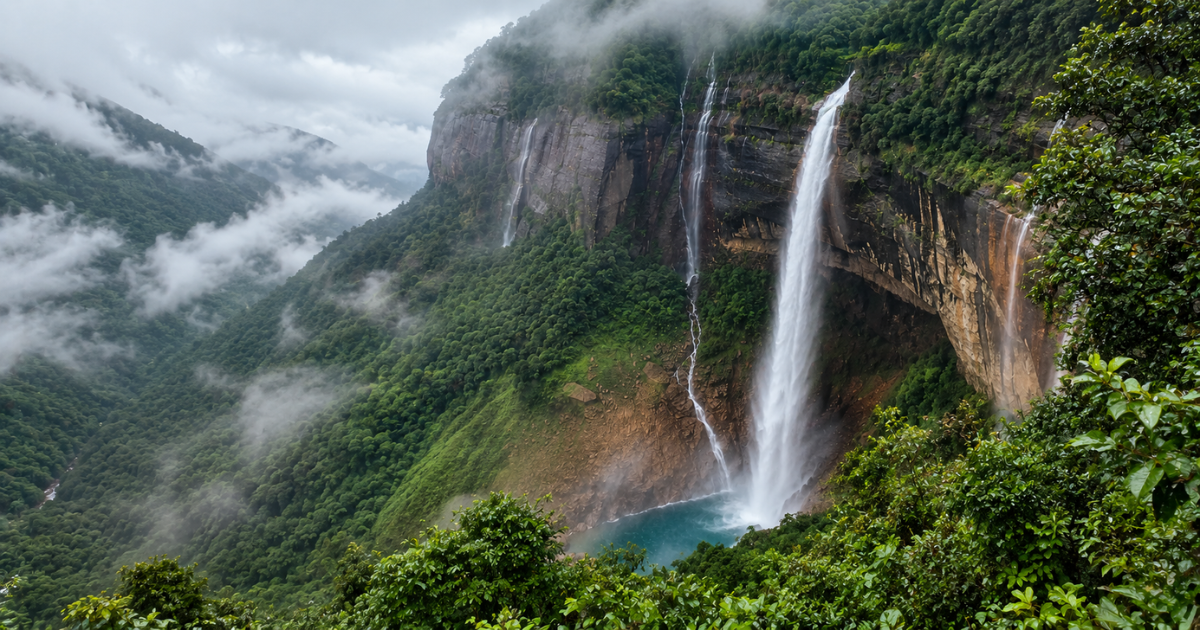
August and September sit right at the tail end of the monsoon in Meghalaya, which locals still call the “abode of clouds” for good reason. The rivers are swollen, the limestone cliffs are streaming with water from every crack or seam, and those falls that just disappear completely in winter are suddenly thundering, like they have something to prove. It’s also the exact window where a few of the state’s more secretive places caves, tucked away drops, blue-water pools turn their whole act on, and do it in a very dramatic way.
“If you’re still weighing which month suits your trip best, our month-by-month guide to the best time to visit Meghalaya breaks down what each season looks like beyond just the waterfalls.”
Why August–September Is the Sweet Spot for Meghalaya’s Waterfalls
Meghalaya’s monsoon runs from April to September, with most of the intense rain showing up in that middle stretch, June through August. Then by late August, moving into September, you start getting this better mix, like the best of both seasons. The waterfalls are still fully fed and gorged with water, but the everyday downpours begin to space out a bit, so you can actually plan routes and move around in the gaps between showers. Also, the roads that sometimes go closed in July for landslide cleanup are usually reopened by then, but it’s still a good idea to check the situation the very morning you’re driving toward Sohra.
This is also the period when seasonal waterfalls, the ones that are fed purely by rain runoff and disappear in the dry months, are putting on their biggest show. If a waterfall on this list is described as “seasonal,” August–September is genuinely the best, sometimes the only window to see it in full force.
Let Us Plan Your Perfect Meghalaya Waterfall Trip
From Nohkalikai’s dramatic plunge to the hidden pools of Krem Chympe, chasing all 12 waterfalls on your own can eat up your whole trip in travel time alone. Our local experts already know which falls to pair, when the roads are clear, and how to skip the crowds — so you spend your time at the waterfalls, not stuck figuring out the route.
Waterfall Comparison Table
| Waterfall | Location | Best Time | Difficulty | Good For |
| Nohkalikai Falls | Sohra | Jul–Sep | Easy | Photography, first-timers |
| Seven Sisters Falls | Sohra (Mawsmai) | Jul–early Sep | Easy | Iconic views |
| Elephant Falls | Near Shillong | Jun–Aug | Easy | Families, quick stops |
| Krang Suri Falls | Amlarem, Jaintia Hills | Jul–Sep | Moderate | Swimming, blue-water photos |
| Wei Sawdong Falls | Near Sohra | Jul–Sep | Moderate | Trekkers, offbeat lovers |
| Dainthlen Falls | Near Sohra | Jul–Sep | Easy (view only) | Photography |
| Langshiang Falls | West Khasi Hills | Jul–Sep | Difficult | Scale seekers, remote spots |
| Rainbow Falls | Nongriat | Jul–Sep | Difficult | Trekking enthusiasts |
| Wah Kaba Falls | Sohra road | Monsoon | Easy | Quiet stopovers |
| Kynrem Falls | Thangkharang Park, Sohra | Jul–Sep | Easy | Families, senior travellers |
| Krem Chympe Waterfall | East Jaintia Hills | Monsoon | Moderate–Difficult | Adventure, offbeat travel |
| Phe Phe Falls | Jaintia Hills | Jul–Sep | Moderate | Escaping crowds |
The 12 Best Waterfalls to Visit in Meghalaya
1. Nohkalikai Falls
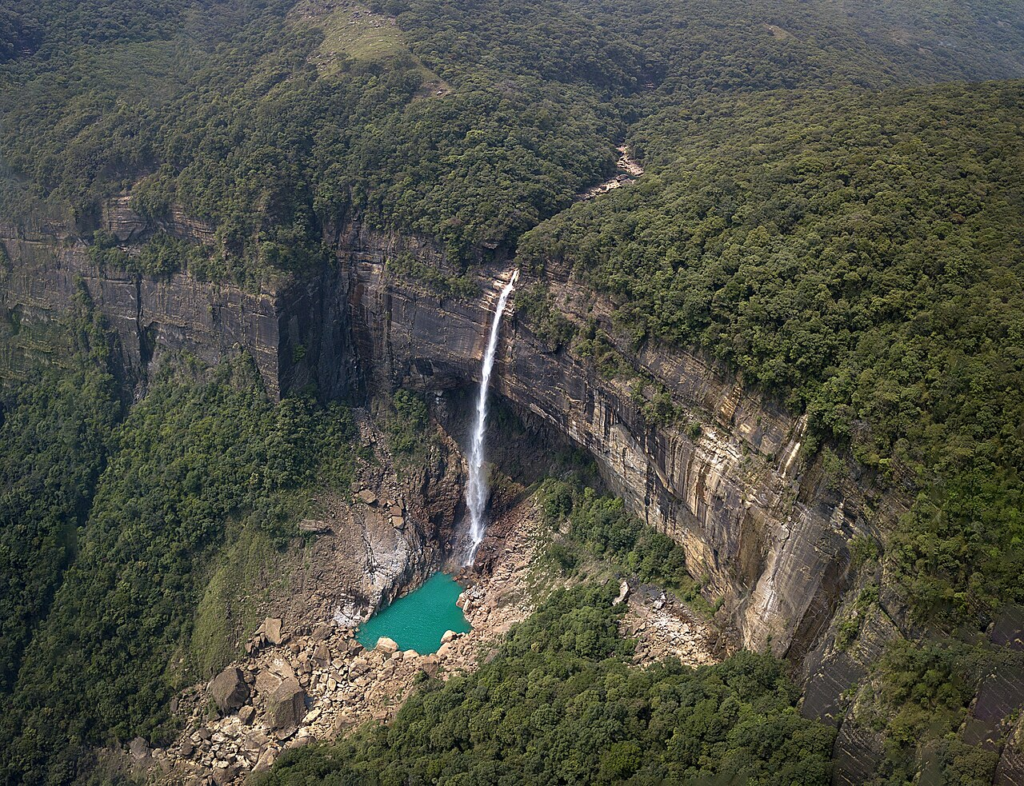
Sitting in the East Khasi Hills, right on the edge of the Cherrapunji plateau, Nohkalikai manages to hold the title of India’s tallest plunge waterfall, that one big nonstop drop of roughly 340 metres (1,115 feet) across a width of about 23 metres. And unlike other waterfalls that are powered by a wide river network, Nohkalikai gets its water purely from rain soaking the top of a relatively small plateau. So it gets noticeably thinner during the dry stretch between December and February, then it comes back stronger once the rains actually begin. Down at the bottom there’s a plunge pool people talk about, especially for an odd, almost jade green tone to the water, it’s not exactly something you forget.
There’s also this famous local legend hanging around the falls. The tale says a woman called Ka Likai from Rangjyrteh village lost her husband and then remarried so she could support her young daughter, but later, her jealous second husband , in a moment of cruelty, killed the child while Ka Likai was away. When she finally learned what happened, grief and fear pushed her to rush to the plateau edge and jump, and that’s why the falls are named after her, like a permanent reminder of the tragedy. Even now locals repeat the story to visitors standing at the viewpoint, and somehow it makes Nohkalikai feel like more than just a quick photo stop, because you’re looking at something with a past.
- Best time: July to September, when rain-fed flow is at its heaviest
- Distance from Shillong: around 55 km, roughly 1.5–2 hours by road
- What to expect: a viewpoint platform, light trekking, and photography that genuinely doesn’t need filters
2. Seven Sisters Falls (Nohsngithiang)
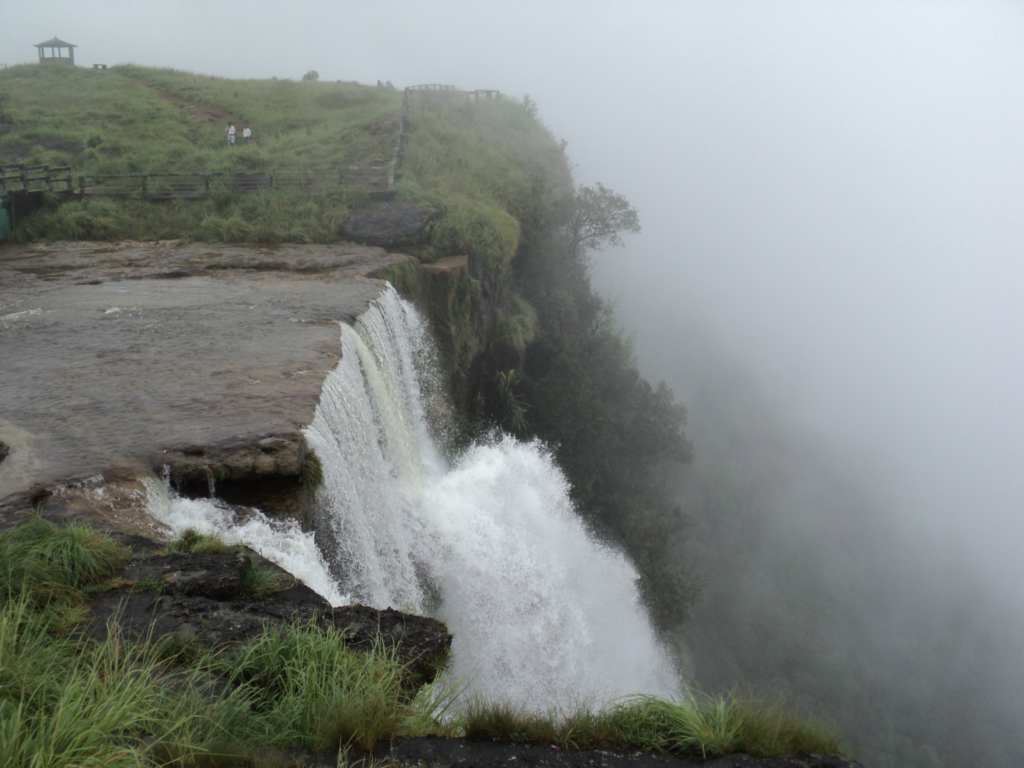
Officially called Nohsngithiang Falls, and also known in the area as Mawsmai Falls, this place is around a kilometre south from Mawsmai village, in the East Khasi Hills. It’s a segmented waterfall, so the seven separate streams run off the same 315-metre (1,033-foot) cliff face, and across a combined width of roughly 70 metres , which is why it shows up among the tallest waterfalls in India. The thing is, it’s fully rain-fed, like no steady flow; the streams only turn up when water is actively sliding over the limestone cliffs during the rainy season. So beyond the monsoon period the “seven sisters” can shrink to a small trickle, or sometimes just disappear completely.
- Best time: July to early September, while the rain keeps all seven streams running
- Height: 315 metres (1,033 feet), spread across a roughly 70-metre-wide cliff face
- Tip: go on a clear morning; the seven streams are far more visible against the limestone when there’s no heavy fog, and locals say the evening light picks up striking colour on the falling water
3. Elephant Falls
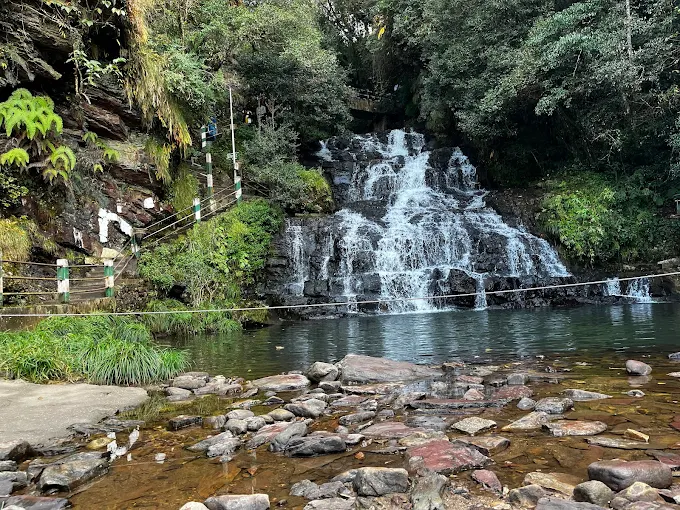
This one is probably the most accessible waterfall on the whole list, around the outskirts of Shillong in Upper Shillong. Its original Khasi name is Ka Kshaid Lai Pateng Khohsiew, which roughly means “ the three-step waterfall ”and people around there still say it the same way. The English name came later from British-era visitors who noticed a rock nearby that looked a bit like an elephant, though that rock was later destroyed in an 1897 earthquake, way before most of today’s visitors ever actually reach the falls.
What you end up walking down to, is really a set of three distinct drops, not just one continuous thing: first you get a broad drop tucked among trees, then a smaller second fall that can seem fairly modest during drier months, and finally a dramatic third fall where clear water crashes over sharply shaped rocks.
- Best time: June to August
- Distance from Shillong: about 12 km, near Mattilang Park in Laitmynsaw
- Entry: a small ticket fee applies (around ₹20), plus a separate camera charge — carry cash
- Good for: families, first-time visitors, anyone short on time before a flight out of Shillong airport, though the stairways down to each tier are steep and can get slippery in the rain
4. Krang Suri Falls
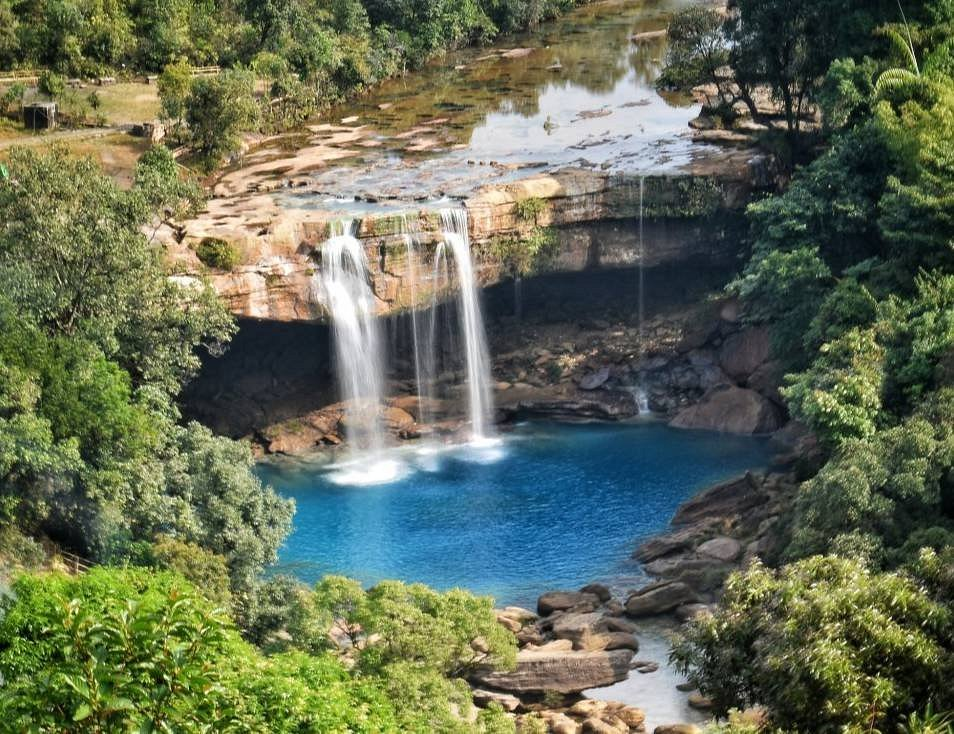
Krang Suri sits in the Amlarem Civil Sub-Division of West Jaintia Hills district, which is the headquarters in the town of Jowai. This district is set in the Meghalaya subtropical forest belt and it is known for heavy limestone deposits, so maybe that is why the water runs so clear. It is the waterfall that keeps showing up in every “Meghalaya tour guide” Instagram post for that almost unreal blue-green colour, and there is a real walking trail too, with bright stone paths leading down to the pool.
- Best time: July to September
- What to expect: swimming is allowed in the designated area, and it gets busy on weekends
- Local tip: visit early morning to avoid crowds and get the clearest water colour in photos
Ready for Meghalaya’s Offbeat Waterfalls?
The falls ahead — Wei Sawdong, Langshiang, Rainbow Falls, Krem Chympe — reward the effort, but they’re not spots you want to find on your own. Steep trails, unclear routes, and unpredictable monsoon conditions make a local guide less of a nice-to-have and more of a necessity here.
5. Wei Sawdong Falls
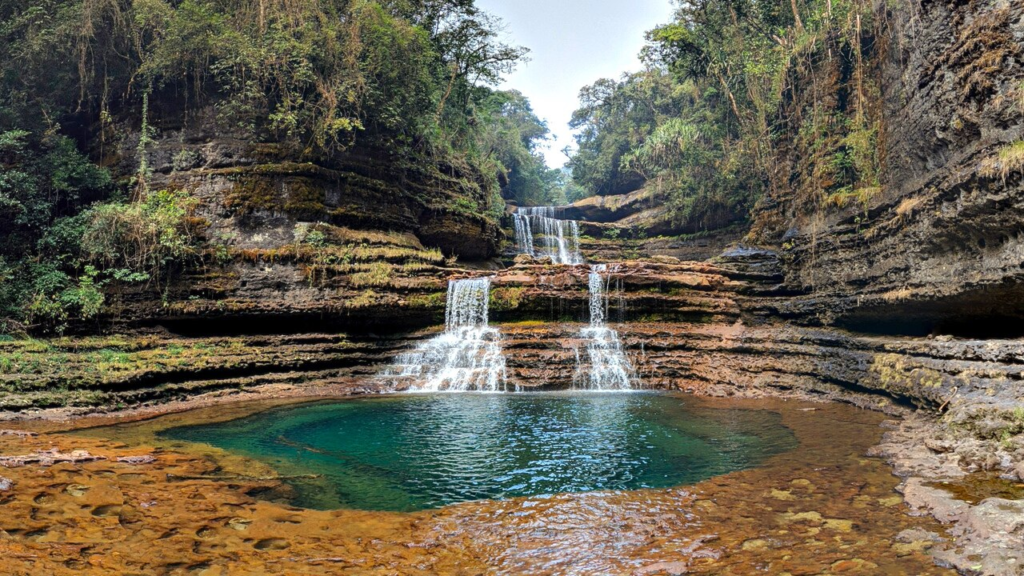
There’s this three tiered waterfall near Cherrapunji, in the East Khasi Hills, about 60 km to the southwest of Shillong, and pretty near Dainthlen Falls. People say the name comes from Khasi “wei” which is like a pool, and “sawdong” meaning square shaped, which matches the falls’ stepped, boxy pools. They’re known for water so clear it comes out bluish green, though actually reaching the place is real hard work, not some carefree easy wander. The route is an out and back walk, rated difficult, so expect a tough trek more than a simple stroll.
- Best time: July to September
- Difficulty: challenging — a steep out-and-back trail that gets slippery in rain
- Who it’s for: travellers who don’t mind a bit of a climb for a quieter, more offbeat experience
6. Dainthlen Falls
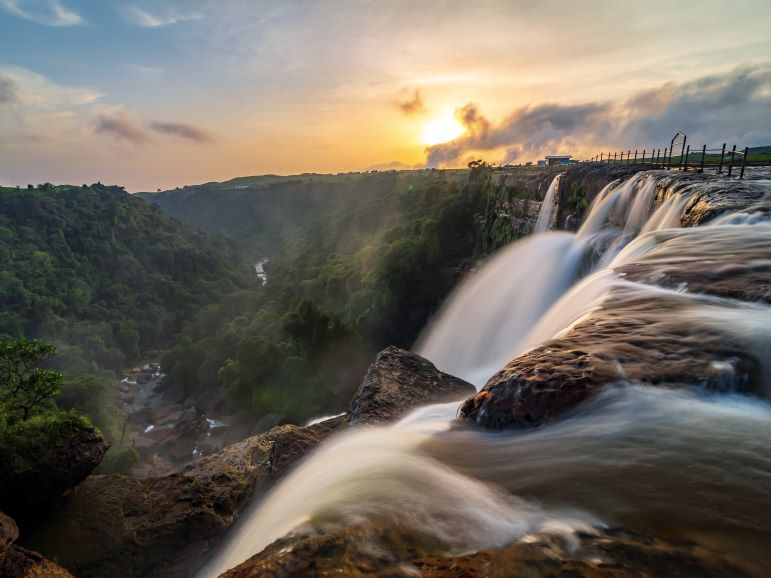
Also near Sohra there’s this steep, 96-metre vertical drop connected to local legend. According to the tale, some mythical serpent was brought down here. It’s a pretty dramatic waterfall to look at but the rocks around it are genuinely slippery, so this one is for photos, not swimming.
- Best time: July to September
- Note: unsafe for swimming due to slick rock surfaces near the edge
7. Langshiang Falls
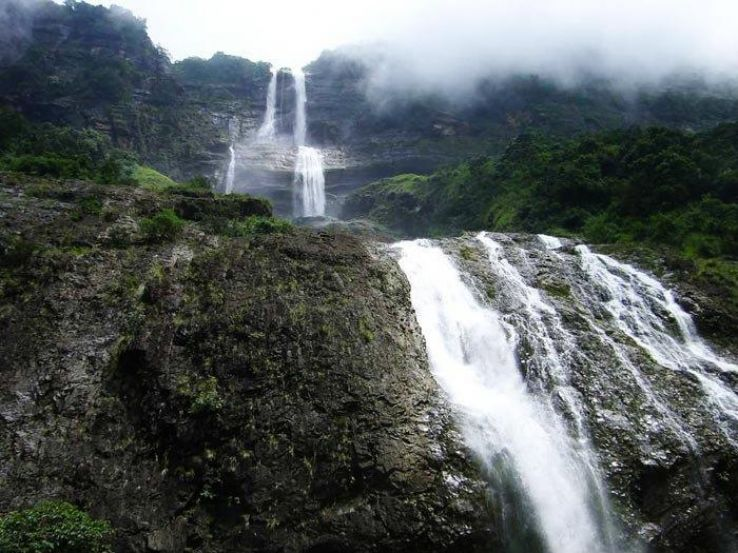
It’s situated near Sangriang village, in West Khasi Hills district, roughly 24 km away from Nongstoin, though it can also be viewed from Mawpon village. The falls are fed by the Kynshi River, and the total drop is often given as about 337 metres (1,106 feet), which if that figure is correct, would put it among the tallest waterfalls in India. Locally, people also call it Kshaid Ur-Nar. Upstream, the river tends to broaden into a still water pool known as Wei Spi, and this area is held in place by steep cliffs, before the water finally tumbles into the gorge that makes up Langshiang.
- Best time: monsoon months, July to September
- How to reach: roughly a 30-minute walk from Sangriang village after a longer drive from Shillong — this is a spot where a guide really pays off, since it’s far less signposted than the Sohra circuit
8. Rainbow Falls
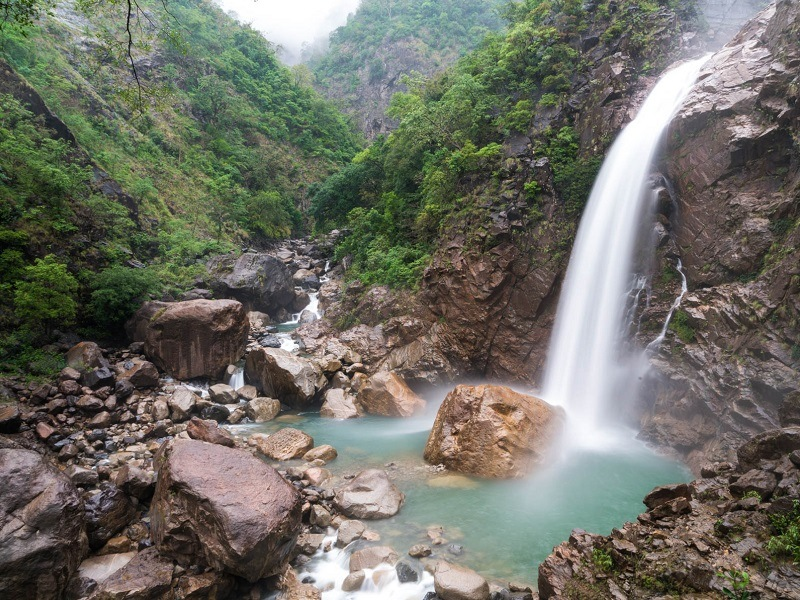
Tucked deep in the Khasi Hills, around Nongriat village, it’s roughly 18 km from Cherrapunji, and you really only get there by trekking past the well known double decker living root bridge. The name comes from the small rainbow you can spot in the waterfall spray when sunlight hits it just right, it is not promised every single visit , but it’s common enough that people plan around that chance. The walk though, is a whole lot of work, with thousands of stone steps and a few swinging suspension bridges through thick forest, and that is also part of why the falls have stayed pretty unspoiled.
- Best time: post-monsoon is popular for clearer skies and a better shot at the rainbow, but August–September still gives you full water volume
- Trek time: roughly 3–4 hours one way from Nongriat, on top of the descent from Tyrna to Nongriat itself — plan for a full day, or an overnight stay in Nongriat if you’d rather split the trek across two days
9. Wah Kaba Falls
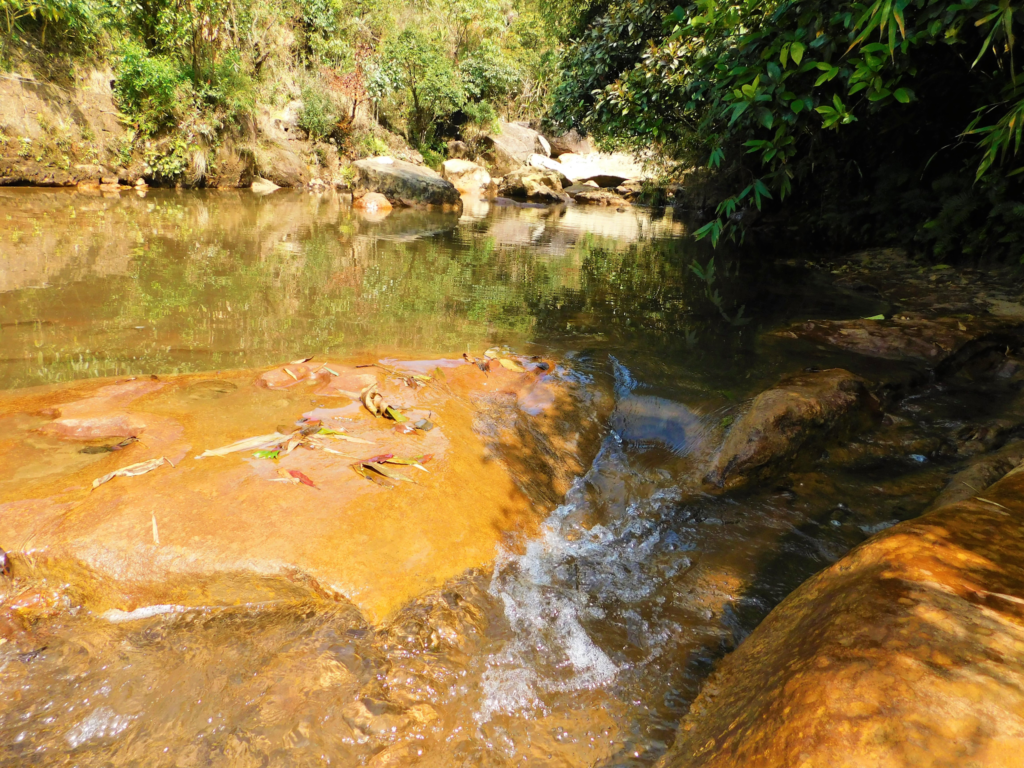
A quieter waterfall on the Shillong-to-Cherrapunji road that most tour buses drive straight past. It drops roughly 170 to 190 metres down a steep rock face into a gorge, and carries its own bit of folklore. Locals say two fairies live at the falls, which is a story you’ll likely hear if you stop at the viewpoint.
- Best time: monsoon season
- Good for: a short, peaceful break during a longer Sohra day trip; there’s a dedicated viewpoint right off the road
10. Kynrem Falls
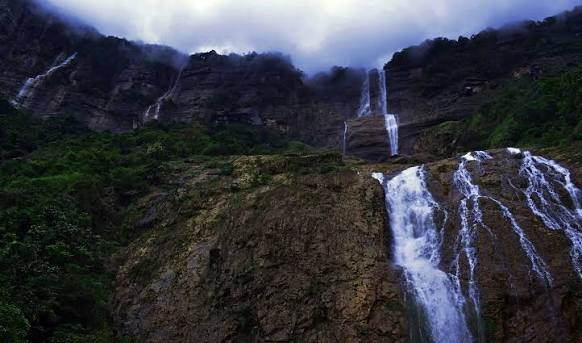
Located inside Thangkharang Park, about 12 km from Cherrapunji in the East Khasi Hills. It’s a three-tiered waterfall dropping a total of 305 metres (1,001 feet), which ranks it among the seven highest waterfalls in India. What makes it a little different from the others on this list is how it flows the water splits into two separate streams partway down and only merges again on the final tier, so you actually watch two rivulets become one before the last drop.
- Best time: July to September
- What to expect: a manicured park setting with a designated viewing gallery at multiple heights, making it one of the more comfortable stops on this list for older travellers or anyone travelling with kids
11. Krem Chympe Waterfall (Chympe Falls)
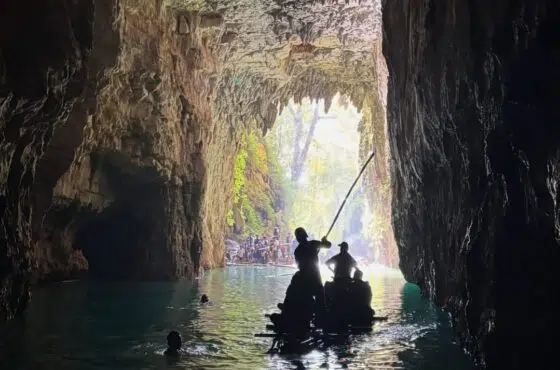
This is the one people look for once they’ve finished the usual circuit and they want something few other tourists have actually seen. Krem Chympe, also written as Piel Khlieng Pouk in cave surveys, runs from the village of Khaddum to Sielkan in the Jaintia Hills, and at 12,434 metres (roughly 40,790 feet) of surveyed passage, it’s ranked as the fifth-longest cave system in Meghalaya , and also in India.
It’s a river cave, so for long sections you end up wading or swimming past more than 50 natural limestone dams (they’re called gours locally), some are standing around 6 to 8 metres tall, plus there’s a big resident bat colony. Right outside the cave mouth is Chympe Waterfall, it pours into a turquoise pool and, most times, that pool is totally empty of other visitors .
- Best time: monsoon and just after, when the underground streams and the waterfall are both at their fullest
- Difficulty: moderate to difficult — a 2 to 2.5-hour trek one way through forest paths and stream crossings, plus optional bamboo-raft boating inside the cave
- Why it’s on this list: this is genuinely one of the most memorable Meghalaya krem chympe tour experiences you can book, and it rarely appears on standard Meghalaya tour packages, which keeps it uncrowded
- Note: hire a local guide — Google Maps does not reliably navigate to Khaddum village, and the trail isn’t signposted
12. Phe Phe Falls
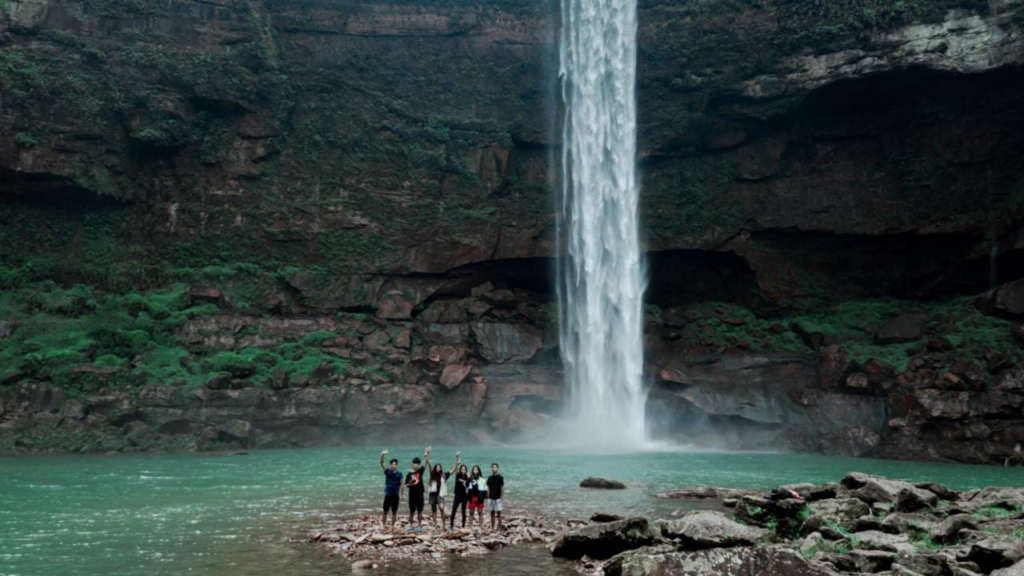
Also in the Jaintia Hills, often paired with a Krang Suri visit on the same day since they’re relatively close together. It’s a quieter alternative when Krang Suri gets crowded on weekends, with the same characteristic clear water.
- Best time: July to September
- Good for: travellers doing a Jaintia Hills waterfall day rather than the more touristy Sohra circuit
Planning Tips for a Monsoon Waterfall Trip
- Give yourself at least 5 to 6 days if you want to cover Sohra, the Jaintia Hills, and a proper trek like Rainbow Falls or Krem Chympe without rushing.
- Pack for rain, not just for — photos a poncho or dry bag matters more here than an umbrella once you’re on a trekking trail.
- Check road status before heading to Sohra, especially after heavy overnight rain. Landslide clearing can delay drives by an hour or two.
- Hire a local guide for offbeat spots like Langshiang and Krem Chympe. This isn’t optional caution. Google Maps genuinely struggles in this part of Meghalaya, and locals know which stream crossings are safe on a given day.
- Don’t swim where locals don’t swim. Falls like Dainthlen look inviting but have a real reputation for slippery rock edges.
- Combine nearby falls into single days. Krang Suri and Phe Phe pair well; Nohkalikai, Seven Sisters, and Dainthlen can all be covered around Sohra in one long day.
Having run these routes for a long time now, our honest take is that most first-time visitors overplan the famous falls and underplan the travel time between them. Meghalaya’s roads are scenic but slow, and rain adds to that. Build in slack rather than a tight hour-by-hour schedule.
Turn This Waterfall List Into a Real Itinerary
You’ve seen the 12 best waterfalls Meghalaya has to offer this monsoon — now let’s build the route around them. Whether it’s a quick 3-day Sohra loop or a full 7-day trip covering the Jaintia Hills and Krem Chympe, The Shillong Tours can put together a plan that fits your dates, pace, and budget.
Final Thoughts
Meghalaya really never seems to run out of waterfalls, no matter how many trips you squeeze in. The thing that changes, each season is more about which falls are actually worth the drive, and August–September is one of the better windows to see them at full strength without getting hit by the worst of the July downpours. Whether you’re chasing the big scale of Nohkalikai, the deep colour of Krang Suri, or you want something calmer, like the Krem Chympe waterfall and cave set up, this part of the year feels like it rewards at least a little planning.
And if you’d rather not deal with road conditions, guides, and permits by yourself, that’s where The Shillong Tours comes in. They put together simple day trips out of Sohra, plus longer, more offbeat itineraries that are built around spots like Krem Chympe. Get in touch, and we’ll help shape a route around whichever waterfalls on this list are calling you first.
Frequently Asked Questions
1. What is the best time to visit waterfalls in Meghalaya ?
The waterfalls are usually at their fullest from June to September, with July and August being the peak. August and September give a decent balance of strong water flow and slightly more predictable weather compared to the heaviest July rain, so that’s often the safer bet.
2. Which are the best waterfalls to visit in Meghalaya ?
Nohkalikai Falls, Seven Sisters Falls, and Elephant Falls are the more famous ones, known for height and relatively easy access. Meanwhile, Krang Suri Falls and Krem Chympe Waterfall are the go to picks if you want more picturesque views and something offbeat, rather than just the standard list.
3. Is Cherrapunji (Sohra) safe to visit in August ?
Yes, generally. Sometimes the roads close for a short while after really heavy rain, so it’s smart to check local updates before you set off , but Sohra stays one of the most visited areas of Meghalaya during the monsoon.
4. How many days do I need for a Meghalaya waterfall tour ?
Most travellers need around 5 to 7 days to comfortably cover Shillong, Sohra, and the Jaintia Hills. That usually includes at least one trekking day, for places like Rainbow Falls or Krem Chympe.
5. Can you swim in the waterfalls in Meghalaya ?
Some waterfalls , like Krang Suri Falls, have designated swimming areas. Others, like Dainthlen Falls, are not safe for swimming because the rocks can be slippery. So follow local signs, or just ask your guide , before you even think about entering the water.
6. What is the tallest waterfall in Meghalaya ?
Nohkalikai Falls near Sohra is widely recognized as India’s tallest plunge waterfall, dropping roughly 1,115 feet into a pool below.
7. Is Krem Chympe worth visiting ?
Yes, especially if you’ve already seen the more mainstream falls. It pairs India’s fifth-longest cave with a secluded waterfall and underground pools, and it tends to be far less crowded than the popular Sohra circuit, too.
8. Do I need a guide to visit Meghalaya’s waterfalls ?
For the easier, more reachable ones like Elephant Falls or Seven Sisters, not really. But if you’re aiming for offbeat, a bit trek heavy spots like Langshiang Falls, Rainbow Falls, and Krem Chympe then yes, a local guide is strongly advised, not only for finding the way but also for day to day safety stuff.
9. What’s a decent route for a first-timer Meghalaya trip with waterfalls?
Shillong → Elephant Falls → Sohra (Nohkalikai, Seven Sisters, Dainthlen) → Jaintia Hills (Krang Suri, Phe Phe, or Krem Chympe) → Dawki is a pretty solid, general tour flow. You can add Krem Chympe as an extra half or full day if you’re the adventure traveller who doesn’t mind walking longer routes, and slightly more “let’s figure it out” vibes.
10. Is Meghalaya safe for families and solo travellers during monsoon?
Mostly yes, but monsoon travel demands a bit of extra planning, especially for road conditions, slippery patches and making sure you have proper trekking footwear. Most family-leaning spots like Elephant Falls and Kynrem Falls usually have smoother access, while the more remote waterfalls are more suitable for fitter, adventure minded travellers, who can handle longer trails without rushing too much.